Frankenstein and the Creature (1818 novel)
Frankenstein; or, The Modern Prometheus is Mary Shelley's 1818 novel about Victor Frankenstein, a young scientist who builds a living being and then abandons it. Shelley began the story at eighteen, during a ghost-story contest in 1816. Her nameless Creature, intelligent and desperate for companionship, is one of the founding figures of fiction about made beings.
Public-domain art
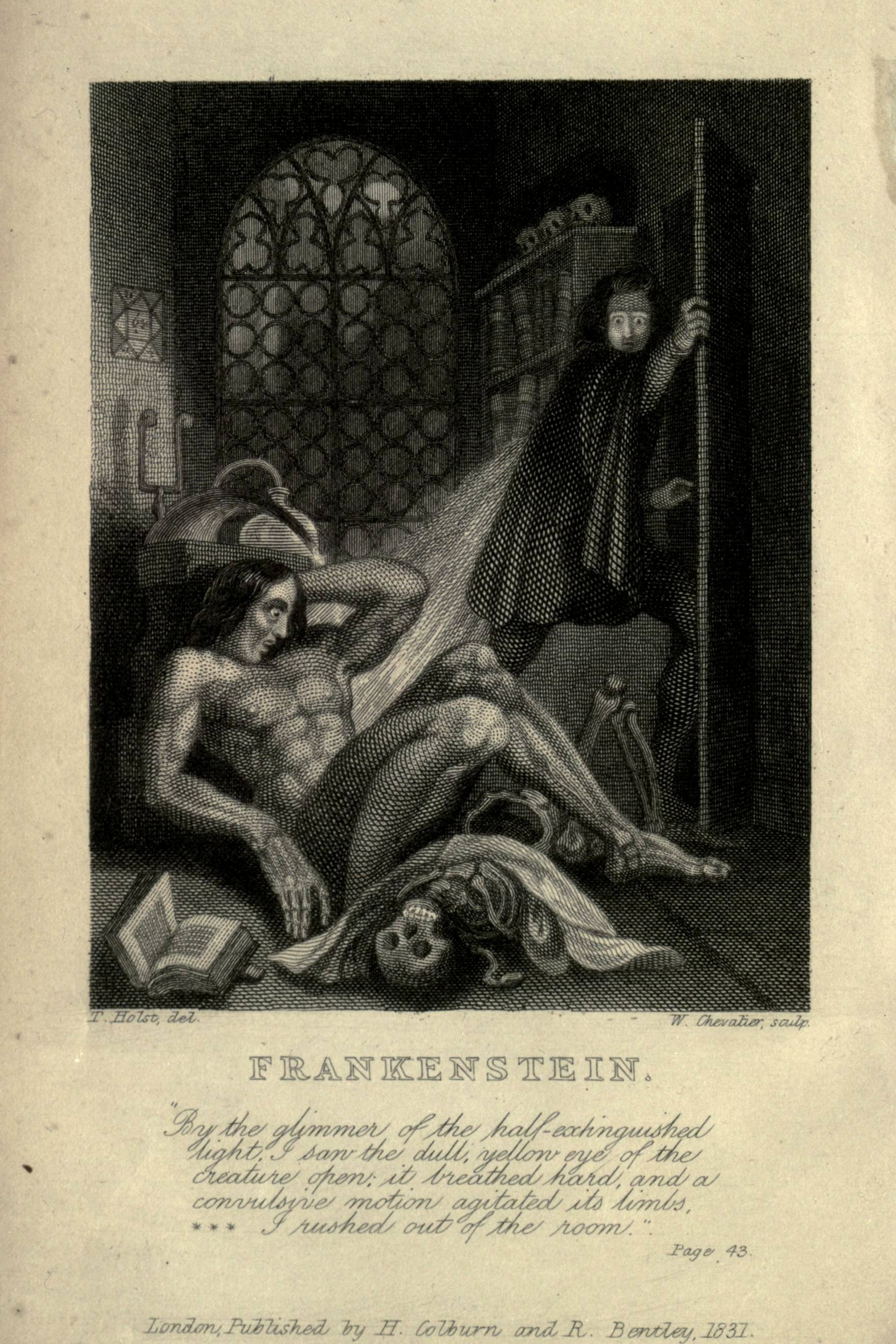
Theodor von Holst, frontispiece to Frankenstein, 1831, London (Henry Colburn and Richard Bentley). Public domain in the United States (published before 1931). Source: Internet Archive scan of the University of Toronto copy, accessed 18 November 2026. View the source scan
Independent fan reference. Not affiliated with the rights holders.
Facts at a glance
- Title
- Frankenstein; or, The Modern Prometheus
- Medium
- Novel
- First published
- 1 January 1818, London, anonymously, in three volumes
- Revised edition
- 1831, with a new introduction by the author
- Author
- Mary Shelley
- Origin
- United Kingdom
- Built being
- The Creature
- Public domain
- Yes, in the United States (the novel's text)
- First film adaptation
- Frankenstein (1910), Edison Manufacturing Company, directed by J. Searle Dawley, with Charles Ogle as the Creature
What is Frankenstein, and where did the story come from?
In the cold, stormy summer of 1816, Mary Godwin, soon to marry the poet Percy Bysshe Shelley, stayed near Lake Geneva with Percy, Lord Byron and Byron's physician John Polidori. Byron challenged the group to each write a ghost story. Mary's idea grew into a novel, published anonymously in London on 1 January 1818, followed by a revised edition in 1831 with her own introduction about how the story began.
The subtitle, The Modern Prometheus, points to the Greek myth of the Titan who shaped humans from clay and stole fire for them. Shelley puts that power in the hands of a student of natural philosophy and asks what he owes the being he makes.
What is the origin story and plot?
The novel opens in the Arctic, where the explorer Robert Walton rescues an exhausted Victor Frankenstein from the ice and writes down his story. As a student at Ingolstadt, Victor discovers how to give life to lifeless matter and builds a being about eight feet tall. The moment it opens its eyes, he is horrified and runs.
Alone and rejected wherever it goes, the Creature teaches itself to speak and read by secretly watching a family of cottagers, the De Laceys, and by reading Paradise Lost, Plutarch's Lives and The Sorrows of Young Werther. When the family drives it away, it turns its grief on its maker and asks Victor for a companion of its own kind. Victor begins the work, then destroys it, and the Creature takes revenge on the people he loves. The chase ends where the book began, in the frozen north.
What can the Creature do, and how big is it?
Victor builds the Creature about eight feet tall, working at a large scale because the smallest parts slowed him down. Its yellow skin barely covers the muscles and arteries beneath, its hair is long and black, and its eyes are watery. It is far stronger and faster than a person, survives cold and hunger that would kill a human, and lives on berries and nuts.
Its most striking ability is its mind. The Creature teaches itself language, reasoning and history, and argues with Victor in long, eloquent speeches. In the novel it is a thinker who feels everything, not a lumbering brute. The flat head and neck bolts many people picture belong to later films, not to Shelley's book.
How does Frankenstein fit among robots in culture?
Frankenstein arrived a century before the word robot, which comes from Karel Čapek's 1920 play R.U.R., yet it sets out the questions robot stories still ask. What does a maker owe the thing it makes? Can an artificial being have feelings and rights? What happens when a creation is rejected by the people it was made to live among?
The Creature is made of flesh rather than metal, but its story runs through later fiction about androids and AI, from machines that want to be accepted to machines that turn on their makers. Isaac Asimov even coined the phrase "Frankenstein complex" for the fear of one's own creations, a sign of how deeply the novel shaped the way people talk about robots.
How might Frankenstein influence the future of this technology?
Frankenstein's enduring question is responsibility. In the novel, the trouble begins less with Victor's experiment than with his decision to abandon what he made. Robotics and AI debates return to that idea again and again: who is accountable when a built system causes harm, how designers test what they release, and how machines are introduced to the people who will live alongside them.
The book also has something to say about appearance. The Creature is judged on sight, before it speaks. Designers of real humanoid and social robots think hard about how a machine's face and body shape people's trust, and the Humanoid and Companion categories show how varied those choices are today.
More than two centuries on, Frankenstein is still a common reference point whenever a new technology seems to come alive.
The Creature
The Creature
A being about eight feet tall, built and brought to life by Victor Frankenstein, who teaches itself to speak and read and turns on its maker after being rejected by everyone it meets.
The directory does not currently list a close functional match for this being.
Related category: Humanoid robots (a related category, not a named pairing)
Character pages
Find the novel and related books
As an Amazon Associate I earn from qualifying purchases. Geppetto may earn a commission if you buy through links on this page, at no extra cost to you.
Editions and related reading:
- Frankenstein 1818 text editions on Amazon
- Annotated editions of Frankenstein on Amazon
- Frankenstein audiobooks on Amazon
- Mary Shelley biographies on Amazon
No prices are shown. Availability changes.
Related works
The Edison Manufacturing Company's Frankenstein (1910), directed by J. Searle Dawley with Charles Ogle as the Creature, was the first film adaptation. The Library of Congress restored the only known surviving print in 2018.
Frequently asked questions
Who wrote Frankenstein?
Mary Shelley. The novel was first published anonymously in London on 1 January 1818, and a revised edition followed in 1831.
Is Frankenstein the name of the monster?
No. Victor Frankenstein is the scientist. The being he makes has no name in the novel and is usually called the Creature.
How old was Mary Shelley when she started Frankenstein?
She was eighteen when she began the story in the summer of 1816.
Why is it called The Modern Prometheus?
In Greek myth, Prometheus shaped humans from clay and stole fire for them. Victor Frankenstein likewise creates life and pays a price for it.
What was the first Frankenstein film?
Frankenstein (1910), made by the Edison Manufacturing Company and directed by J. Searle Dawley, with Charles Ogle as the Creature.
Is Frankenstein in the public domain?
Yes. Mary Shelley's novel is in the public domain in the United States. Later adaptations and film designs may still be protected.
Sources and further reading
- Wikipedia, "Frankenstein", accessed 18 November 2026 en.wikipedia.org/wiki/Frankenstein
- Project Gutenberg, Frankenstein; Or, The Modern Prometheus (1818 text), accessed 18 November 2026 www.gutenberg.org/ebooks/41445
- Library of Congress, "The First Film Version of Frankenstein, Newly Restored!", accessed 18 November 2026 blogs.loc.gov/now-see-hear/2018/10/frankenstein-post/
- Internet Archive, Frankenstein (London: H. Colburn and R. Bentley, 1831), University of Toronto copy, accessed 18 November 2026 archive.org/details/ghostseer01schiuoft
- Wikimedia Commons, "Frankenstein.1831.inside-cover.jpg" (public domain), accessed 18 November 2026 commons.wikimedia.org/wiki/File:Frankenstein.1831.inside-cover.jpg