The Creature from Frankenstein (1818 novel)
The Creature is the nameless being Victor Frankenstein builds and brings to life in Mary Shelley's 1818 novel Frankenstein. About eight feet tall, enormously strong and startlingly intelligent, it teaches itself to speak and read, longs for a friend, and turns against its maker only after being rejected by everyone it meets.
Public-domain art
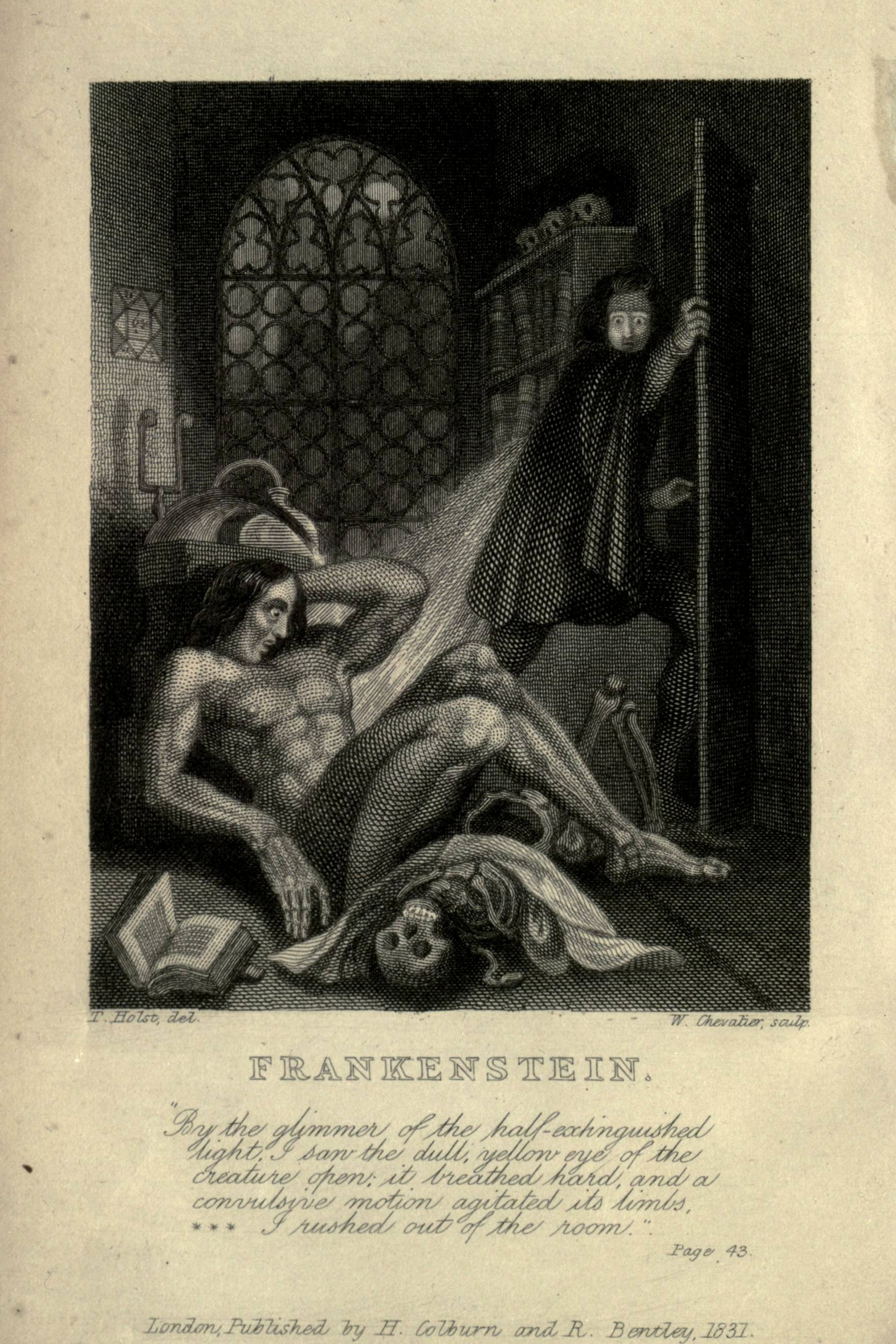
Theodor von Holst, frontispiece to Frankenstein, 1831, London (Henry Colburn and Richard Bentley). Public domain in the United States (published before 1931). Source: Internet Archive scan of the University of Toronto copy, accessed 18 November 2026. View the source scan
Independent fan reference. Not affiliated with the rights holders.
Facts at a glance
- Name
- None in the novel; Victor calls it the creature, the being and the daemon
- Appears in
- Frankenstein; or, The Modern Prometheus, Mary Shelley, 1818
- Made by
- Victor Frankenstein, a student at Ingolstadt
- Height
- About eight feet, as Victor describes it
- Appearance in the novel
- Yellow skin over visible muscle and arteries, long black hair, watery eyes
- Abilities
- Great strength, speed and endurance; teaches itself language and reasoning
- Books it reads
- Paradise Lost, Plutarch's Lives, The Sorrows of Young Werther
- First film portrayal
- Charles Ogle, in Edison's Frankenstein (1910)
- Similar real robot
- No close match in the directory; see Humanoid robots
Does Frankenstein's monster have a name?
No. In the novel, Frankenstein is the maker, Victor, and the being he makes is never named. Victor calls it the creature, the being, the daemon and worse. The Creature compares itself to Adam, the first man, and to the fallen angel of Paradise Lost, two figures from the book that taught it about creation and rejection.
Calling the Creature "Frankenstein" came later, through stage and screen versions, and it has stuck so well that the name now stands for both maker and made.
How is the Creature made?
Victor gathers materials from charnel houses and dissecting rooms and works alone for months in his lodgings at Ingolstadt. He refuses to explain his method, telling Walton the secret is too dangerous to share, so the novel never spells out the science. In her 1831 introduction, Shelley mentions galvanism, the experiments with electricity and living tissue that fascinated her circle, and later adaptations made lightning and laboratories the heart of the scene.
What does the Creature learn, and what does it want?
Hiding in a shed beside the De Lacey family's cottage, the Creature learns language by listening, then learns to read from the family's lessons and a satchel of books it finds. It discovers history, poetry and its own loneliness at the same time.
What it wants is simple: a companion. It asks Victor to build a mate and promises that the two of them will live far from people, in the wilds of South America. Victor's refusal, after he starts the work and tears it apart, is the turning point of the novel.
Is the Creature a robot?
Not in the mechanical sense. The Creature is assembled from organic material, not metal and motors, and the word robot did not exist until Karel Čapek's 1920 play R.U.R. But the Creature set a template many artificial beings in fiction have followed: built by a person, alive in a new way, and asking whether it deserves a place in the world.
The directory does not pair the Creature with a named robot. The Humanoid category shows today's human-shaped machines, which face their own questions about how people react to a body that is almost human.
Similar real robot
The directory does not currently list a close functional match for this being.
Related category: Humanoid robots (a related category, not a named pairing)
Find the novel and related books
As an Amazon Associate I earn from qualifying purchases. Geppetto may earn a commission if you buy through links on this page, at no extra cost to you.
Editions and adaptations in print:
- Frankenstein 1818 text editions on Amazon
- Frankenstein graphic novels on Amazon
- Frankenstein audiobooks on Amazon
No prices are shown. Availability changes.
Frequently asked questions
Does Frankenstein's monster have a name?
No. The being has no name in the novel. Frankenstein is the scientist who made it.
How tall is Frankenstein's Creature?
About eight feet tall, as Victor Frankenstein describes it in the novel.
How does the Creature learn to talk?
By secretly listening to the De Lacey family through a gap in their cottage wall, then learning to read from their lessons and from books it finds.
Who first played the Creature on film?
Charles Ogle, in the Edison Manufacturing Company's Frankenstein (1910).
Is the Creature a robot?
Not a mechanical one. It is made of organic material, but it set the pattern for later robots and androids in fiction.
Sources and further reading
- Wikipedia, "Frankenstein", accessed 18 November 2026 en.wikipedia.org/wiki/Frankenstein
- Project Gutenberg, Frankenstein; Or, The Modern Prometheus (1818 text), accessed 18 November 2026 www.gutenberg.org/ebooks/41445
- Library of Congress, "The First Film Version of Frankenstein, Newly Restored!", accessed 18 November 2026 blogs.loc.gov/now-see-hear/2018/10/frankenstein-post/
- Internet Archive, Frankenstein (London: H. Colburn and R. Bentley, 1831), University of Toronto copy, accessed 18 November 2026 archive.org/details/ghostseer01schiuoft
- Wikimedia Commons, "Frankenstein.1831.inside-cover.jpg" (public domain), accessed 18 November 2026 commons.wikimedia.org/wiki/File:Frankenstein.1831.inside-cover.jpg